How to Tell Which Competitor Facebook Ads Are Actually Working (Without Spend Data)
Meta won't show a competitor's spend or ROAS. These six signals in the Ad Library show which of their Facebook ads are working, with a real example.
Every ad your competitors run on Facebook and Instagram is sitting in the Meta Ad Library, free to browse. The catch is that the library shows you what a brand is running, not what is working. A DTC brand can launch twenty creatives on a Monday and switch off seventeen of them by Friday. If you study all twenty, you learn as much from the losers as from the winners.
This guide is about finding the few ads a competitor keeps paying for. Meta does not publish spend or results for normal commercial ads, so everything below is inference. But the inference is good, because brands leave a trail when an ad works: they keep it running, they copy it into more ad sets, and they make more versions of it.
What the Meta Ad Library shows, and what it hides
Search a brand's name or open its Facebook Page, and the Ad Library lists every active ad that Page is running across Facebook, Instagram, Messenger and Meta's Audience Network. For each ad you can see:
- the creative (image, video or carousel) and the full ad copy
- "Started running on", the date the ad first went live
- the platforms it runs on
- the link it sends people to
- a "This ad has multiple versions" note when the same ad is running with different copy or formats
What you cannot see, for ordinary commercial ads outside the EU: spend, impressions, clicks, conversions, ROAS or targeting. Ads shown in the EU carry more detail under the Digital Services Act, such as reach and the age, gender and location targeting, and political and social-issue ads show spend in every country. For a supplement or skincare brand advertising in the US, you are working with dates, duplicates and versions.
That is enough, if you read them the right way.
Six signals that a competitor's ad is working
1. It has been running for a long time
Every day an ad stays live, someone at that brand chose to keep paying for it. Media buyers switch off losers quickly, often within a week. So the start date is the strongest single clue you have.
A rough way to read it:
- Under 2 weeks: still a test. Interesting, not proven.
- 30 days or more: it survived its first test.
- 90 days or more: a likely winner, or an evergreen ad the brand trusts.
One caveat: a brand with a small, always-on budget can leave a mediocre ad running for months. That is why you check the next signals too.
2. The same creative appears in many ads
The Ad Library lists ads, not creatives. When a brand scales a winner, it usually duplicates it into new ad sets, campaigns and audiences, so the same video or image shows up again and again with a different ad ID. Ten listings of one video is a much stronger signal than ten different videos.
Count the creative, not the listings. If you only scroll the feed, a brand with 300 ads looks busy. Once duplicates are grouped, it might have 40 creatives, and five of them account for half the listings.
3. It has several copy or format versions
"This ad has multiple versions" means the brand is running the same ad with different text, headlines or formats, often through Meta's dynamic creative. Brands don't bother writing new versions of an ad they are about to switch off. Iteration means investment.
The versions also tell you what the brand is testing. In our library, Paleovalley ran a 59-second creator video twice with copy that differs only in punctuation: "Two bags for $60. That's either a mistake..." and "Two bags for $60? That's either a mistake...". Someone thought the question mark was worth a test. That level of attention usually goes to an ad that is already working.
4. It survived a launch batch
Brands rarely launch one ad at a time. They launch a batch, read the results, and keep the survivors. You can see this in the start dates: a cluster of ads that all started on the same day.
Come back a few weeks later and see which ads from that batch are still live. The survivors are the winners of that test, and you just got the results for free.
5. The brand keeps making new versions of the same idea
Look past individual ads to the ideas behind them. If a brand has shot the same hook with three different creators, or turned one testimonial into a static, a short video and a carousel, that concept is working well enough to justify more production. The angle is the thing worth learning from, not the specific ad.
6. It points at a page built for it
Note where each ad sends people. A brand that builds a dedicated advertorial, listicle or offer page for a set of ads is investing behind them. If several long-running ads share one landing page, study that page as closely as the ads. (We wrote up what those pages have in common.)
| Signal | Where you see it | What it suggests | Watch out for |
|---|---|---|---|
| Long runtime | "Started running on" date | The brand keeps paying for it | Small always-on budgets |
| Same creative in many ads | Duplicate media across listings | Being scaled into more ad sets | Hard to spot by scrolling |
| Multiple versions | "This ad has multiple versions" | Being iterated on | Dynamic creative can be automatic |
| Survived a batch | Ads sharing a start date | Won its test | Need two looks, weeks apart |
| New versions of one idea | Same hook or angle, new execution | The concept works | Takes reading, not counting |
| Dedicated landing page | The ad's link | Money behind the funnel | Generic homepages tell you little |
A real example: Paleovalley in July to October 2026
Here is what these signals looked like for one brand in our library. On July 9, 2026, Paleovalley started 21 new creatives on the same day: statics for its bone broth protein, beef sticks and whey, plus creator videos.
By mid-October, more than three months later, the whole batch was still live. That tells you something on its own: this brand runs a steady, always-on mix instead of switching losers off fast, so runtime alone can't separate its winners. Reuse and versions can. Two ads stand out:
- A creator video pitching a buy-one-get-one deal on bone broth protein. It opens with the price ("Two bags for $60?") and does the per-serving math on camera. It runs in two copy versions, the punctuation test above.
- A static "LAST CHANCE: BOGO on Paleovalley's Bone Broth Protein" image, reused across more than one ad with two copy versions.
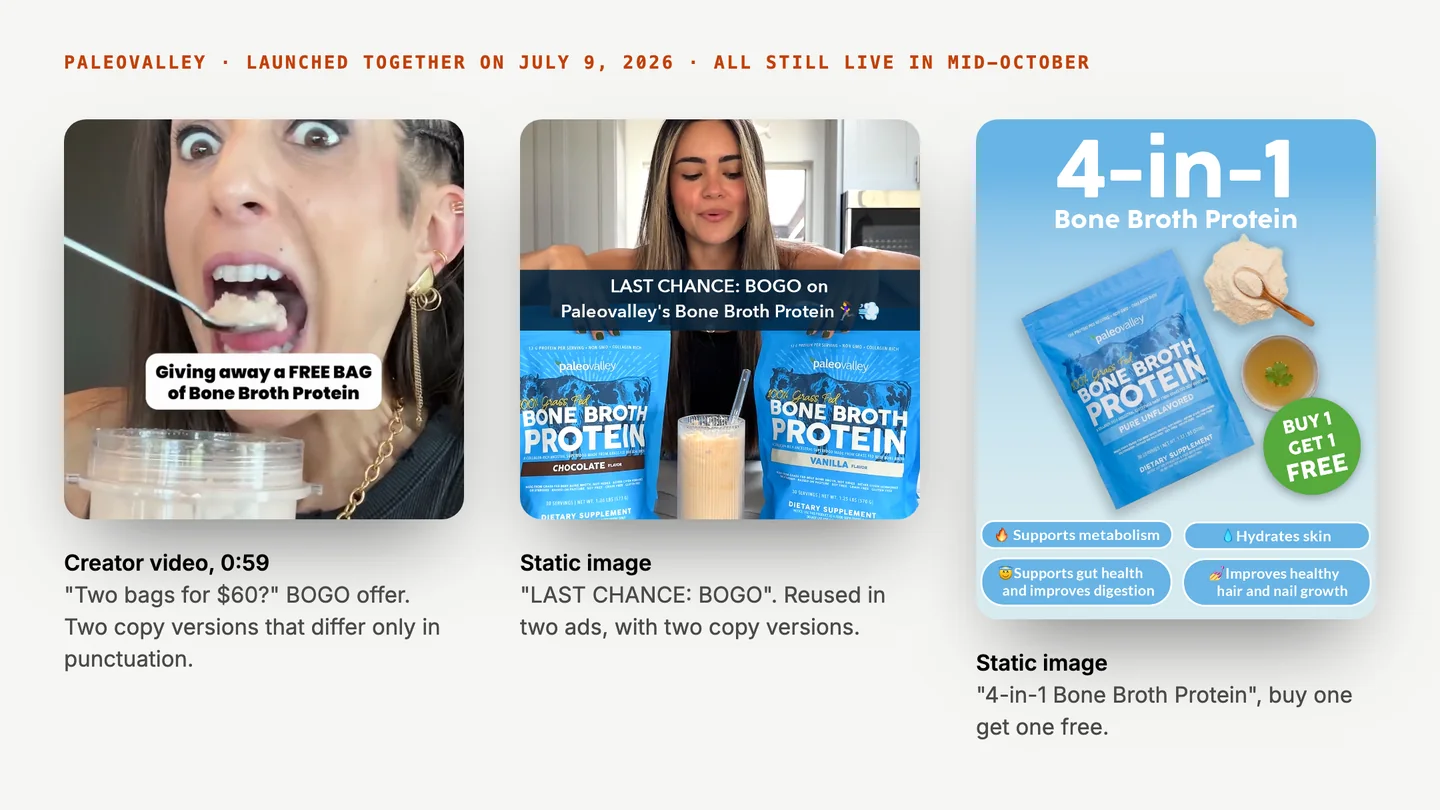
Read together, the signals say the ads the brand was putting the most work behind were a BOGO offer, one delivered by a creator doing the math out loud and one as a static it duplicated into more ads. That is a brief you could write in five minutes: an offer-led creator video that leads with the price and makes the deal feel like a mistake.
Notice what we did not do. We did not copy the ad. We copied the structure: open on the offer, prove it's a good deal, let a real person say it.
A 15-minute weekly routine
You don't need a tool to start. You need a list and a habit.
- List 5 to 10 competitors. Include one or two brands outside your category that are good at ads.
- Open each brand in the Ad Library. Set the country you sell in, all platforms, and active ads only.
- Note anything 30 days or older. Write down the start date.
- Check versions and duplicates. Open ads with multiple versions and look for the same media repeated.
- Capture the parts, not the ad. For each likely winner, write down the hook (the first line or first three seconds), the angle, the offer, the format and the landing page.
- Compare with last week. What launched, what died, what survived?
- Turn one pattern into a brief. One good brief a week beats a folder of 400 screenshots.
Mistakes that waste the research
- Treating new as good. A fresh ad is a question, not an answer. Let it age before you learn from it.
- Copying the ad instead of the idea. Lifting a competitor's footage or copy is a copyright and brand problem, and it rarely works because your offer and audience are different. Borrow the structure.
- Ignoring the country filter. A brand can run completely different ads in the US and the UK. Look at the market you sell in.
- Reading runtime alone. Cross-check long runtimes with duplicates and versions before you call something a winner.
- Taking one look. Inactive ads can drop out of view, and you cannot spot survivors without two looks a few weeks apart. Save what matters when you see it.
Doing this for 20 brands without a spreadsheet
The routine works for five brands. At twenty, it becomes a part-time job. That is the job adintel does.
- Brand tracking: checks every tracked brand's ads daily and alerts you to new ones.
- Deduplication: groups the same media into one creative, with its runtime, ad count and copy versions.
- Winning signal: ranks creatives by the same evidence as this guide: runtime, reuse, versions and Meta's own labels. We show it as a signal, not a measured result, because Meta does not publish performance for these ads.
- AI read: pulls out the hook, angle, offer and persona of every ad.
- Landing pages: captures and analyses the page behind each ad.
There is a 7-day free trial if you want to run this on your own competitors.
FAQ
Can you see a competitor's Facebook ad spend?
Not for normal commercial ads outside the EU. The Meta Ad Library shows spend for political and social-issue ads, and more detail (such as reach) for ads shown in the EU. For everything else, use the signals in this guide: runtime, duplicates and versions.
How long does an ad need to run to count as a winner?
There is no official number. As a rule of thumb, treat 30 days as "survived its test" and 90 days or more as "likely winner", then confirm with duplicates and versions.
Is it okay to look at competitors' ads?
Yes. Meta built the Ad Library so anyone can see the ads running on its platforms. Learning from what competitors run is normal practice. Copying their creative assets is a different matter, because their footage, images and copy belong to them.
Does the Meta Ad Library include Instagram ads?
Yes. It covers ads running across Meta's platforms, including Facebook, Instagram, Messenger and the Audience Network, and shows which platforms each ad runs on.
How often should I check competitors' ads?
Weekly is enough for most brands. Daily matters during big sales periods, or when you want to catch a competitor's new launch while it is still a test.